- DeFi Dev Corp. (Nasdaq: DFDV)
- Posts
- Mar. 2026 Recap: Strengthening the Foundation
Mar. 2026 Recap: Strengthening the Foundation
With market activity slowing, we continued advancing research, partnerships, and capital strategies designed to support long-term SOL per share growth.
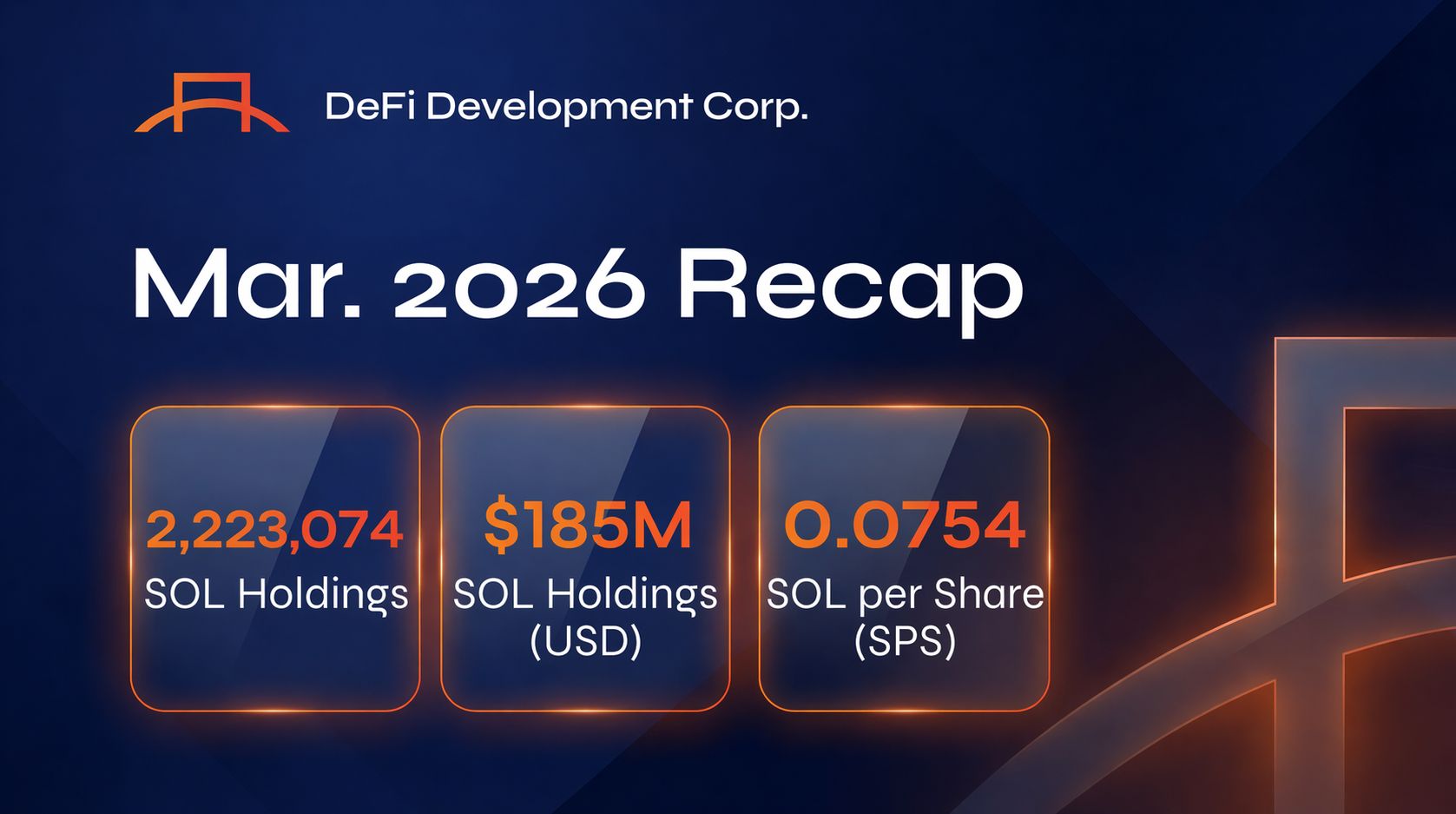
March was a quieter month for the Digital Asset Treasury (DAT) vertical, reflecting the broader cooldown across crypto markets and in capital formation. As sentiment remained soft and activity across DATs slowed, DeFi Development Corp. stayed focused on the work we believe matters most in this kind of environment: pursuing avenues that can help grow our SOL balance over time and, in turn, increase SOL per Share (SPS).
That meant continuing to publish original research, deepening ecosystem integrations, engaging with shareholders and institutional audiences, and advancing longer-term initiatives that we believe can strengthen DFDV’s position when conditions improve. Here is what we accomplished in March.
Here’s what went down last month. 👇️
Month-End Statistics
SOL Holdings: 2,223,074 SOL
SOL Holdings Value: $185M
Shares Outstanding: 29,497,394
SOL Per Share (SPS): 0.0754 SOL
dfdvSOL Supply: 656,764.82 dfdvSOL
DFDVx (Tokenized DFDV) Trading Volume: $20.5M

FY 2025 Results: +442% Revenue Growth
We closed the month by reporting full-year 2025 results and publishing our shareholder letter and business update. The headline number was clear: DFDV reported +442% revenue growth for FY 2025, underscoring how far we’ve come since repositioning around a SOL-first Digital Asset Treasury strategy. The release also pointed shareholders to a full business update and management video featuring Joseph Onorati (CEO), John Han (CFO), Parker White (CIO & COO), and Dan Kang (CSO).
More importantly, the earnings release reflected something broader than a single revenue figure. It marked the continued transition of DFDV from a rebranded public company into a more fully built-out platform spanning validator operations, onchain treasury activity, tokenized equity, ecosystem integrations, and institutional capital markets strategy. March did not just give us a new financial data point. It gave us another opportunity to show that the operating base behind the story is expanding.
A link to our annual shareholder letter can be found here.
Agentic AI Research: Extending the SOL Demand Model

On March 10, we published one of our most important pieces to date, “Every Agent Needs a SOL: Sizing the Opportunity for Agentic Finance on Solana”. The report is a deep dive into one of the levers powering our valuation model for Solana, as we outlined in our “SOL & the Digital City: A New Way to Value Layer 1 Tokens” report, published in February. The central conclusion was that autonomous AI agents could create persistent and structural demand for SOL over time.
The report laid out a $27B base case for structural SOL demand from agentic AI alone and a $112.5B bull case, with the spread driven by differing assumptions around how large the agent economy ultimately becomes. It also introduced a bottom-up framework for estimating SOL demand per agent and examined current transaction and volume data, including x402 micropayments and Artemis-based reads on real versus gamed activity. More broadly, the report extended our effort to move SOL valuation away from vibes and toward a more rigorous demand-side framework rooted in real economic activity.
Apyx Deep Dive: Why We Invested and Why It Matters
Following our February 2026 investment announcement, we hosted a dedicated X Spaces replay in March to explain what Apyx is, why we helped incubate it, and why we believe it could become a meaningful value driver for DFDV over time. The discussion featured DK, Parker, and Joseph and walked through the mechanics of Apyx’s two-token model, the logic behind dividend-backed stablecoins, and the role preferred equity issued by Digital Asset Treasuries could play in bringing transparent yield onchain.
This mattered for two reasons. First, it gave shareholders a clearer picture of how Apyx fits into DFDV’s broader strategic flywheel. Second, it highlighted the kind of infrastructure we think can sit on top of Digital Asset Treasuries over time. Rather than treating treasury vehicles as passive balance sheets, the Apyx conversation framed them as inputs into a broader digital credit stack, where preferred equity, stablecoins, and onchain capital markets increasingly begin to overlap.
dfdvSOL Adoption Accelerated
One of the clearest operational wins in March came from continued growth in dfdvSOL. Jupiter Lend increased the cap on the dfdvSOL/SOL loop to $30M, after the prior cap had already been fully utilized, opening the door for more users to keep looping the position and deepening dfdvSOL’s presence inside one of Solana’s most important borrow-lend venues. This coincided with dfdvSOL supply rising from 513,451.97 to 656,764.82, a sharp month-over-month increase that points to accelerating product-market fit for DFDV’s LST.
That matters beyond just the raw supply number. dfdvSOL is one of the clearest examples of how DFDV can create operating leverage inside the Solana ecosystem rather than merely holding SOL passively. As integrations deepen and usage expands, the token becomes a more meaningful part of the broader treasury and validator flywheel.
The Onchain Advantage Continued
We also continued investing in educational content through The Onchain Advantage, publishing a new episode on Project Zero, which positions itself as Solana’s first DeFi-native prime broker. In the video, we explored how the platform aggregates liquidity across protocols such as Kamino, Drift, and Jupiter and walked through a USDS rate arbitrage strategy along with the risks inherent in leveraged DeFi positioning.
We then published another episode focused on Solflare, one of the original wallets in the Solana ecosystem and one of the easiest ways for new users to access Solana DeFi. That episode covered wallet setup, funding, swapping, staking, Earn Vaults, tokenized stocks, and Solflare Shield, its NFC-powered hardware security device. These episodes are not side content. They are part of a broader effort to educate both crypto-native and newer audiences on how Solana works in practice and why the ecosystem continues to widen its lead in usability and financial functionality.
Real Vision: Joseph Onorati on DATs, Capital Markets, and the Future of Crypto Credit
March also featured another strong institutional media appearance, with CEO Joseph Onorati joining Real Vision Masterclass: Episode 2 for a long-form discussion on how Digital Asset Treasuries work, why public company structures matter, and how preferred stock, convertibles, and digital credit products could reshape crypto capital markets over time.
The conversation covered why DATs can access forms of leverage unavailable to individuals or smaller private funds, why stakeable assets like SOL create structural advantages relative to non-yielding treasury models, how DFDV thinks about mNAV compression and buybacks in weaker markets, and why variable-rate perpetual preferreds could become a major growth area for the sector. It also gave Joseph room to explain why DFDV chose Solana specifically and how he sees DATs evolving from simple treasury wrappers into more important financial actors inside the crypto economy. In a slower month for hard catalysts, this kind of institutional-grade narrative building mattered.
March 2026 Reddit AMA - Highlights
We wrapped up March with our monthly Reddit AMA inside r/DFDVDegens, where shareholders and community members asked direct questions about Apyx, SPS growth, capital markets strategy, and how DFDV is navigating the current market environment. Below is a brief summary of the key discussions.
Q: What is the status of CHAD, and how does it fit into the Apyx ecosystem?
A: CHAD remains a priority initiative, though timelines have been impacted by broader market conditions and recent SOL price volatility. The expectation is that an initial, smaller allocation could be completed in the coming months, with the potential to scale over time. Within Apyx, CHAD would represent one component of the broader digital credit strategy alongside assets like STRC, contributing to long-term ecosystem growth.
Q: Is DFDV currently generating enough yield to cover expenses and operations? A: Yes. Organic yield, primarily from staking and onchain activity, is currently sufficient to cover operating expenses, including debt service. Some yield has been monetized for opex, while the remainder continues contributing to SOL accumulation or other strategic uses such as buybacks.
Q: How is the company navigating the current market environment?
A: With capital markets more constrained, the focus has shifted toward organic growth and disciplined capital allocation. This includes continuing to generate yield, opportunistically executing buybacks, advancing preferred issuance efforts, and preparing for more favorable conditions. The current environment is also being used to strengthen the company’s positioning ahead of the next cycle.
Q: What is the strategy for attracting new investors given current market dynamics?
A: The positioning remains centered around asymmetric upside. While larger, more established DATs may offer lower risk, DFDV offers greater potential upside in a recovering market. Over the past several months, the team has engaged with dozens of institutional investors, many of whom are beginning to build positions in anticipation of improved market conditions.
Q: How is management thinking about alignment with shareholders?
A: Management emphasized that alignment is driven primarily through significant equity ownership, with leadership collectively owning a meaningful portion of the company. The long-term incentive is clear: value creation comes from growing SOL per share and scaling the business, not short-term compensation. Option grants have also been used as a retention mechanism to maintain a high-quality team in a competitive market.
Q: What role does Apyx play for DFDV today?
A: While still early, Apyx is viewed as a potentially significant long-term catalyst. DFDV has economic exposure through its investment, potential allocations (including CHAD), and broader ecosystem benefits. If successful, Apyx could enhance demand for digital credit instruments and create additional pathways for SPS growth.
Q: What progress has been made on international expansion initiatives?
A: Progress continues across regions. The UK entity is advancing through regulatory processes and is expected to be ready when market conditions improve. Japan is also progressing, with updates expected in the near term. Korea has moved more slowly, but efforts are ongoing.
Q: Did DFDV execute any buybacks or adjust its capital allocation strategy?
A: Yes, the company executed modest buybacks during the period. Going forward, capital allocation decisions will continue to be driven by relative value, with capital deployed toward either SOL accumulation or share repurchases depending on market conditions.
Q: What is currently the primary driver of SOL per share (SPS) growth?
A: In the current environment, organic yield is the primary driver. While less headline-driven than capital markets activity, it remains a consistent and compounding source of growth, with the potential for additional acceleration through preferred issuance and other strategic initiatives.
The TL;DR
March was about reinforcing the thesis.
We reported +442% revenue growth for FY 2025, extended our public SOL valuation work with a new agentic AI research report, deepened the market’s understanding of Apyx and digital credit, continued expanding the educational footprint around Solana DeFi, and kept building relationships with both institutions and the community while dfdvSOL adoption accelerated.
The market may be softer. The mission is not. We remain focused on positioning DFDV as the strongest long-term public vehicle for compounding SOL exposure.
In service of SPS growth,
The DFDV Team
Disclaimer: This is for informational purposes only and reflects publicly announced developments, milestones, and media coverage related to DeFi Development Corp. (“the Company”). The information contained herein does not constitute an offer to sell or a solicitation of an offer to buy any securities, nor should it be relied upon as investment advice or a recommendation regarding any securities. Certain statements in this post may constitute “forward-looking statements” within the meaning of applicable securities laws. These statements are based on current expectations and assumptions and involve risks and uncertainties that could cause actual results or events to differ materially. Readers are cautioned not to place undue reliance on these forward-looking statements, which speak only as of the date of publication. DeFi Development Corp. undertakes no obligation to update any forward-looking statements, except as required by law. All information is accurate as of the date posted and is subject to change without notice.